Monday, March 19, 2012

The Everyday in Venice. Diary entry: Venice, Nov. 8th


While at CafĂ© Florian, the narrator meets with an acquaintance, Miss Romney.  Regarding Venice, she says to him, “But Mr. Burden, is it not awfully-er-dirty?”

My thoughts go back to a time when, discussing our mutual travels in Italy, an acquaintance once described Venice as being “insipid” and unclean.  Indeed, Venice is not for everyone.  Just like dust shows up in the homes of our own lives, so in this city there are places that are not polished perfect, and neat and orderly.  I don’t see this as a shortcoming.  I like seeing spalling stone, and peeling paint.  This reminds us that the city is an ongoing living thing with evolving needs.  I like that here, you can be in the midst of monumentality and world renown and then simply choose another direction.  A direction that will lead you to a place not originally intended as a destination.  A narrow alley, perhaps a dead end that is not as openly inviting and, in that way, draws your curiosity.  I like seeing drying laundry hung on a clothesline outside a home.  I like knowing that everyday life happens here, amidst the tourism and crowds and that when Piazza San Marco begins to empty out at night, life continues elsewhere.  I like knowing that when I leave and return at another time, things won’t be exactly the same.  I like the unexpected, being pleasantly surprised, appreciating beauty in many different types of places be it the ordinary or the world renowned, and for this and many other reasons, I love the city that is Venice.                                           

Thursday, January 19, 2012

21 Benefits of Travel


The narrator’s references to travel have inspired me to reflect on my own passion for traveling outside my home country.  Below are some benefits to traveling that I have experienced throughout my wanderings around the globe.

1.       It prevents stagnation

2.       It opens one’s mind to new ways of living and doing things

3.       It’s a metaphor for life; things don’t always go as planned

4.       You learn to adjust yourself to external forces beyond your control

5.       You are stripped of your usual environment and therefore learn more about yourself

6.       You engage with and make friends with people that have a different background from your own

7.       You learn a new language

8.       You learn patience

9.       You can finally see and appreciate with your own eyes all the places you read about in books

10.   It can inspire you to become more creative

11.   Its brings a sense of adventure into your life

12.   You learn to appreciate different foods

13.   You learn to appreciate different music

14.   You are humbled by how little you are in the vastness of the world

15.   You can revel in the newfound comfort of being a stranger to others

16.   You allow the generosity of strangers to fill you with happiness

17.   You can help clear misconceptions other cultures may have of your culture

18.   You can help clear misconceptions you may have of other cultures

19.   You can find beauty in a place you were not expecting to find it

and therefore

20.   You can gain a new perspective on beauty

and

21.   When you return home with all this fresh outlook on things, you can perhaps discover something new that had been waiting for you all along within your usual surroundings

Sunday, December 11, 2011

Seeing vs. Feeling Venice. Diary Entry: Venice, Nov. 4th


Making reference to tourists pointing with umbrellas at Palazzo Mocinego, the narrator states:

“It assists more than the flaming advertisements of the curiosity shops in making of Venice an exhibition, a something to be seen, not felt.”

What is the difference between something that is seen and something that is felt?  In this context, ‘seeing’ a place implies judgment, whether good or bad; a reaction caused solely by using one’s eyes or outer faculties.  Approaching a place by ‘seeing’ it will limit that experience to either criticism or compliments. ‘Feeling’ implies introspection to get to what one is in fact feeling upon approaching a place.  Approaching a place by ‘feeling’ it will open up possibilities for other thoughts. In this way, the space becomes a springboard or means of inspiration to get to something else, perhaps something about oneself.

I remember quite well the very first time I visited Venice and how I became aware of different parts of who I am, and what I value and enjoy.  Perhaps this is what is meant by feeling Venice.

I am also reminded of the beginning of the movie Summertime in which Katharine Hepburn speaks to the owner of the hotel she will be staying in:  

"I met a girl on the boat coming over…….[who] was coming to Europe to find something…..past seeing things and getting some culture….way back, way, way back in the back of her mind, was something she was looking for."

I am wondering if this difference between seeing and feeling Venice is something that will also be explored later in the book.  

Saturday, November 19, 2011

Venice as a "Leafless City." Diary entry: Venice, Nov. 4th


The sun makes the season in this leafless city; it bathes the golden dome of St. Mark’s in radiant summer light.”

My mind rested after reading this sentence.    

The rhythm of changing seasons is made picturesque with leaves turning warm shades of yellow, red, and orange.  The leaves then fall from their ‘roots,’ shrivel, and are eventually gathered.  They make way for new growth in the future.   

In Venice however, this montage of autumnal colors does not exist.  Yes, the change in weather and start of high tide mark the season’s cycles.  But, what is more evident here is the contrast of light and dark: the radiance of the sun contrasted with the darkness of shadows cast onto facades pealing or well preserved,  sun filled piazzas contrasted with narrow calle that escape its blaze, or a dark moment passing beneath a bridge upon a gleaming canal. 

Here, the constant montage of light and dark is more prevalent than a visual change in seasons.  The reminder of time passing by is the rising and setting of the sun.  This renders Venice almost as if a place outside of time as understood elsewhere; a place in which the lives of those living within and those passing by are what endow it with the passage of time.  

Friday, October 21, 2011

Finding Repose in Venice. Diary Entry: Venice, Nov. 4th


The narrator continues to compliment Venice:

“[Venice] gives one, more than nature, deep calm, sincere repose.  I am not required to have any opinions-to take sides.”

What is it about a place that would make one not have to take sides or have opinions?  For one, there would not be an immense amount of advertisements encouraging purchases or endorsements.  Another would be a slower pace to life, as mentioned in the previous post.  The narrator goes on to state:

“So for three days I have sat about idly, or swung in the tender, cradle-like movement of a gondola.  It seems sometimes as though I were tasting eternity here, among these environments of age.”

When we find ourselves in a place where the demands of everyday life diminish, we dig deeper into ourselves.   Perhaps more than finding our distinct and unique views on things, we emerge not with that which needs to be defended or separates us from others as opinions might do.  But, with that which connects us to others the way wisdom and universal truths do.  

Monday, July 11, 2011

The “Hopelessness” of Venice. Diary entry: Venice, Nov. 4th

San Marco and campanile from Palazzo Ducale

After mentioning being dissatisfied with Venice, the narrator explains that they eventually came to appreciate the city, contrasting it with American civilization:

“….when, indeed, I tired of the continuous rush and roar of our courser, noisier, material civilization,-I turned to Venice again-this time as a lover.  Its hopelessness fascinated me.”

The way I interpret this is that in Venice, “hopelessness” is the city’s love for what it already possesses, without the yearning for something more than it is.  This is quite a contrast to American civilization which constantly has its eye on the future and towards improvement.  In Venice, there is no trying to become or striving for something better.  Its glory lies in its past and the present is an appreciation of its past. 

When we find ourselves in a place like this, we are humbled by the expanse of time before us.  Things are not so immediate.  Things are not so rushed.  The pace of life is slower.   We are but a moment in the vast terrain of time. 

It would be interesting to see if this contrast between two places and ways of thinking and living might play itself out in the novel. 

Sunday, June 19, 2011

First Impressions of Venice and Florence. Diary Entry: Venice, Nov. 4th

Venice: view across a canal
The narrator now makes mention of having been disappointed during their first visit to Venice.  Deteriorating palazzi, odors coming from canals, and dark calle are described, although with admitted feelings of shame towards this first impression.  Like it is said in the opening scene of the classic movie Summertime, people either find Venice too quiet or too noisy, or find it very beautiful.  Just as Jane, played by Katharine Hepburn, insists on her way there, I myself will stick to being among the later.  When I first visited Italy during a summer study abroad program, we landed in Milan and the first city we moved on to stay in was Venice.  I was absolutely breath taken, even overwhelmed with all the beauty around me.  There is a sense of romance that comes from being in a place that has existed for hundreds of years.  But here was something unique that I did not find in the other Italian cities I had then visited; a feeling almost as if you are not inside the city, but rather that the city contains you in its mazelike arms making you lose your direction often indeed, yet that never being a misfortune.  Every turn and bend and rise and descent is and leads to something that is welcoming, invites you, and makes you feel you have arrived somewhere. 

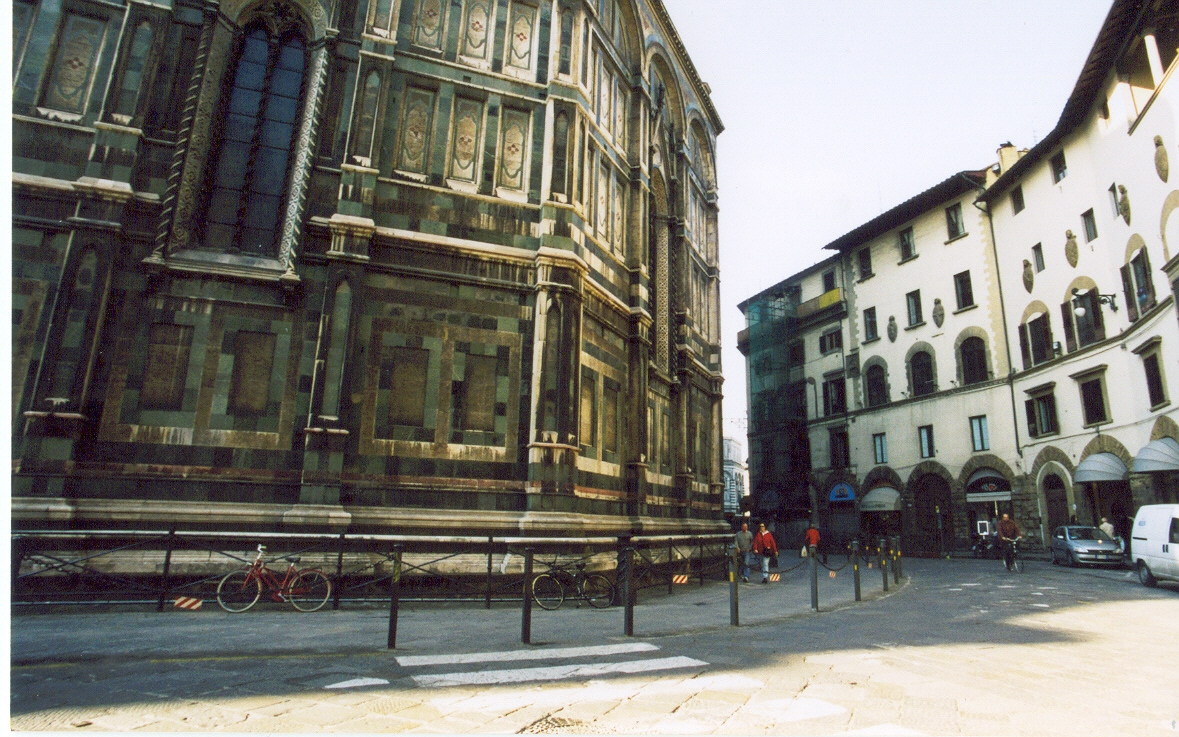
I can, however, somewhat associate with the narrators first impressions of Venice, with my first impressions of Florence, which we visited afterwards.  Florence is a beautiful city.  However, that impression revealed itself to me only after my initial feelings of ambivalence with it had slowly faded.  I would not say that Florence is a mysterious place, the way I would of Venice.  Here everything is out in the open, so to speak.  The architecture of the cathedral, churches, piazzas, and palaces are all very strong and bold reflections of the social and political history of the city at the time that they were built.  It is acceptable here to have statues depicting Perseus beheading Medusa and of the rape of a Sabine woman in one of its most public spaces, the Piazza della Signoria; a space where public executions were even held.  

It is not only the monumental structures and piazzas that have this strong sense to them.  The facade of the church of San Lorenzo has  remained unfinished since it was built, and one can still see the bare, rough structural stonework which was meant to support a decorative facade. Walking down an ordinary street, one can see that the rusticated stones that made up much of the buildings facing the streets are still very much visible even through modern interventions.  I believe there is even a local ordinance that requires that some of the historic stones be visible if the structure is being faced with a new material, as can be seen in the pictures below.  These reminders of the past add a sense of solidarity and permanence to the city, and to find yourself in the backdrop of all this can be quite captivating.  


The cathedral of Florence conveys a sense of dramatic and powerful growth, with the dome above the cathedral culminating from a series of forms below it and the shape of the piazza surrounding the cathedral taking its shape from the floor plan of the cathedral, as if a result of the force of its thrust onto the cityscape.  This can be overwhelming at first, but also dramatic, magnificent, and, when seen from a distance, awe-inspiring.

Santa Maria del Fiore: the cathedral of Florence
The cathedral of Florence and surrounding buildings
The cathedral of Florence seen from a distance
When I had first visited Italy, Florence may not have given me the same romantic first impressions as Venice did, but as I had learned, beauty can reveal itself in places perhaps hidden until sought after with an open eye and mind.